
Holy Week in Cebu: Semana Santa traditions, closures and what to expect
What happens in Cebu during Holy Week, and does it affect getting around?
Short answer
Holy Week, Semana Santa in Filipino, falls in March or April and is one of the most solemn weeks on the Philippine calendar. Maundy Thursday and Good Friday are national holidays: many offices, malls and businesses close or run shortened hours, churches hold processions and Bisita Iglesia visits, and roads and ferries get busier with domestic holiday travel. Cebu itself is where Christianity first reached the Philippines in 1521, so the Basilica del Santo Nino and Magellan’s Cross in the city centre are at the heart of the week. Day tours, resorts and private transfers all keep running, so it is a genuine option to visit, it just rewards booking ahead like any other peak week.
Holy Week, called Semana Santa, is one of the most widely observed weeks in the Philippines, and Cebu has a stronger claim to it than most places. This is where the Spanish expedition led by Ferdinand Magellan landed in April 1521 and baptised the local ruler Rajah Humabon, the first Christian conversion recorded in the country, marked today by Magellan’s Cross and the Basilica del Santo Nino standing side by side in the middle of Cebu City.
None of that means the city shuts down for the week. It means a quieter, more solemn Cebu than the one built around beaches and diving, with real practical effects worth knowing before you plan around it: which days are public holidays, what tends to close, and how the week compares to a normal one for a private transfer or day tour.
Why Holy Week starts here: the Basilica and Magellan’s Cross
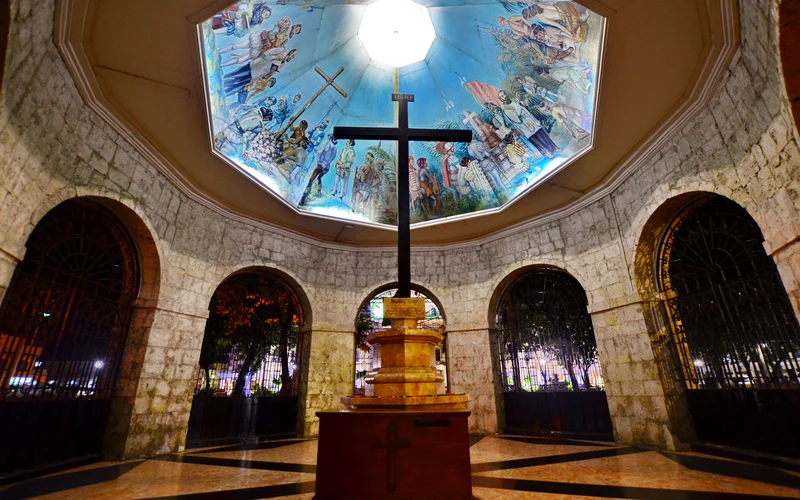
The Basilica del Santo Nino, founded in 1565 and the oldest Roman Catholic church in the Philippines, sits on Plaza Sugbo in the heart of Cebu City. Right beside it stands Magellan’s Cross, housed in its own small pavilion since 1834: the cross planted by Magellan’s expedition on 21 April 1521, six days before Magellan himself was killed at the Battle of Mactan, an event covered in our Lapu-Lapu Day guide. Both sites are National Cultural Treasures and are open to visit any day of the year, not just during Holy Week.
That history is why Cebu’s Holy Week observances run deep: the Basilica holds Good Friday processions and services through the week, and it is also the home of Sinulog every January, the city’s other, very different major religious date, a street festival rather than a solemn one.
What actually happens during Holy Week
Maundy Thursday and Good Friday are both national holidays in the Philippines every year, on the Thursday and Friday before Easter Sunday (the exact dates move with Easter, typically landing in March or April). Many Filipino Catholics observe Bisita Iglesia, visiting several churches in turn to pray, and Good Friday itself is marked by processions and church services rather than celebration, the direct opposite mood of a festival like Sinulog. Black Saturday that follows is quieter still, before Easter Sunday itself.
Maundy Thursday and Good Friday
National holidays. Government offices, banks and many businesses close, and some malls and restaurants run shortened hours or close entirely, especially on Good Friday afternoon.
Bisita Iglesia
A tradition of visiting multiple churches in one day to pray. In Cebu City, the Basilica del Santo Nino and the nearby Cebu Metropolitan Cathedral are commonly included.
Black Saturday and Easter Sunday
The quietest point of the week, followed by Easter Sunday, when normal business hours generally resume.
What it means for a visit or a private transfer
Day tours, resorts, the airport and private transfers all continue operating through Holy Week, it is dry season, so the beaches, Oslob, Kawasan and the islands are all still very much open. What changes is demand: this is one of the biggest domestic travel weeks of the year, alongside Christmas and Sinulog, as many Filipinos travel to be with family, so ferries, resorts and popular restaurants fill up and it is worth booking your driver or transfer earlier than you would for a quieter week.
If you would rather see Cebu’s religious side than avoid it, Holy Week is a genuinely good time to build a Cebu City morning around the Basilica del Santo Nino and Magellan’s Cross before heading south or out to the islands. If you would rather skip the crowds and closures, the dry-season weather and the coast and islands are unaffected either way, just allow a little more time getting through the city on Good Friday itself if a procession is under way nearby.
Frequently asked questions
When is Holy Week in Cebu?
Holy Week, Semana Santa, follows the Christian calendar, so it moves each year, typically landing in March or April. Maundy Thursday and Good Friday, the two national holidays in the week, are the days most worth planning around.
Does Cebu close down for Holy Week?
Not entirely. Government offices, banks and many businesses close on Maundy Thursday and Good Friday, and some malls and restaurants run shortened hours, but resorts, day tours, the airport and private transfers all keep operating through the week.
What is Bisita Iglesia?
A Filipino Catholic tradition of visiting several churches in one day to pray, commonly done during Holy Week. In Cebu City the Basilica del Santo Nino and the Cebu Metropolitan Cathedral are among the churches commonly included.
Can you visit Magellan’s Cross and the Basilica del Santo Nino during Holy Week?
Yes. Both sit side by side on Plaza Sugbo in Cebu City and are open year-round, though expect a livelier, more crowded Basilica during Holy Week itself, when it holds Good Friday processions and services.
Is Holy Week a good time to visit Cebu?
Yes, with two things worth knowing: it is one of the busiest domestic travel weeks of the year, so ferries, resorts and drivers are worth booking ahead, and Good Friday in particular is solemn rather than festive, closer in mood to a quiet Sunday than a celebration.