
Cebu with kids: car seats, drive times and what actually works with young children
What is travelling around Cebu with young children actually like?
Short answer
Cebu is a straightforward place to travel with children: English is spoken everywhere, families are welcome in most places you would want to go, and the distances are manageable if you plan around them. The one thing worth sorting before you land is the car seat. Under Republic Act 11229, the Child Safety in Motor Vehicles Act of 2019, a child must be secured in a child restraint system until they are at least 150 centimetres (59 inches) tall and can use the regular seat belt, and no child aged twelve or under may travel in the front seat unless they meet that same height. Arrivals is a bad place to discover that. Tell us your children’s ages, heights and weights when you request a quote and the right seats are in the vehicle before pickup. After that it is mainly a question of drive times: the highlands are 30 to 45 minutes from Cebu City, Carcar is 1 to 1.5 hours, Moalboal is 2.5 to 3, and Oslob and Kawasan are a 3 to 4 hour run each way.
Most of what makes Cebu easy for adults makes it easy for children too. English is spoken everywhere, so there is no language barrier at a pharmacy or a restaurant, the food is mild by regional standards, and the beaches, waterfalls and the whale sharks at Oslob are the kind of thing children remember for years. What catches families out is not the destination. It is the two hours in the car each way, and the car seat that nobody arranged.
This guide covers both. First the legal position on child restraints in the Philippines, which is stricter than a lot of visitors expect and is not something a taxi or a ride-hailing app will solve for you at the airport. Then the practical part: how far each of our regular destinations really is, which of them are realistic with a toddler, and what to tell us so the vehicle that turns up is the right one. Every drive time below is the same figure published on our own route and destination pages.
The Philippine car seat law, in plain English
The governing law is Republic Act 11229, the Child Safety in Motor Vehicles Act, approved on 22 February 2019. It is worth reading the two operative rules carefully, because they are written around height rather than age, which is the opposite of what most visitors assume.
The restraint rule is about height, not age
Section 4 requires a child to be properly secured in a child restraint system at all times while the engine is running, unless the child is at least 150 centimetres (59 inches) tall and is properly secured with the regular seat belt. The seat must suit the child’s age, height and weight, which is why a single generic seat does not cover a family of three different sizes.
No child of twelve or under in the front
Section 5 prohibits any child aged twelve or under from sitting in the front seat while the vehicle is being driven, unless they meet the same 150 cm height requirement and wear the regular belt. The Act defines a "child" as anyone twelve years old and below.
The penalties fall on the driver
Section 10 fines the driver ₱1,000 for a first offence, ₱2,000 for a second, and ₱5,000 plus a one-year licence suspension for a third. It is the driver who is liable, not the passenger, which is a large part of why we would rather fit the seat than improvise.
Seats must be approved, not just present
Section 6 ties approval to United Nations Regulation 44 and Regulation 129, and requires seats sold in the Philippines to carry a Bureau of Product Standards PS mark or an ICC licence. Expired seats are specifically prohibited under Section 7.
There are narrow exemptions
Section 4 sets these aside during a medical emergency, where the child has a medical or developmental condition, or in analogous circumstances set by the implementing rules. It also states that a child must never be left unaccompanied by an adult in a vehicle, restrained or not.
Where the law stops, and why that matters on the ground
Two gaps are worth knowing about, because they explain what you will actually see out of the window in Cebu.
The Act’s definition of a motor vehicle in Section 3 expressly excludes tricycles and motorcycles. That is a limit on the scope of the law rather than a judgement about safety, and it is why you will see small children riding on both. Separately, Section 9 does not settle the question for public utility vehicles at all: it directs the Department of Transportation to study whether child restraints are workable in jeepneys, buses, taxis, vans and ride-hailing service vehicles, and to recommend other measures where they are not.
The practical consequence for a visiting family is simple. A pre-arranged private vehicle is the setting where a properly fitted, correctly sized seat is actually achievable, because someone knew your children’s sizes before the day started. A taxi rank at 11pm is not.
Tell us the ages, the heights and the weights
We arrange child seats in advance. It has always been an ask-and-we-fit-it arrangement rather than something that appears automatically, so it needs to come with the quote request rather than being mentioned to the driver on the day. Tick "We need a child seat" on the quote form and put the ages, heights and weights in "Anything bulky?" - that is what decides which seats we fit.
Send the ages, and the rough heights and weights alongside them. The law requires a restraint appropriate to all three, and those are the numbers that decide whether a child needs an infant carrier, a forward-facing seat or a booster. Ages on their own leave a genuine guess in the middle. If you would rather bring your own seat you are welcome to, and it still counts as luggage for the purposes of sizing the vehicle, so tell us that too. Tick "We need a child seat" on the quote form and put the ages, heights and weights in "Anything bulky?" - that is what decides which seats we fit.
How far is comfortable in one go
This is the part that decides whether a day out is a success. Cebu’s distances look modest on a map and take longer than the map suggests, because the roads are single carriageway for most of their length. The figures below are our published private-car times, one way, and they are the honest bands rather than best-case runs.
Under an hour, easy at any age
Mactan-Cebu Airport to a Cebu City hotel is 30 to 60 minutes, longer in peak traffic. The Cebu Highlands, with the Temple of Leah and the ridge viewpoints, are 30 to 45 minutes up from the city. Both work as a first afternoon with a tired child.
One to two hours, fine with a nap
Carcar is 1 to 1.5 hours from Cebu City. Simala Shrine is 1.5 to 2. These are the realistic half-day options with a toddler, and they pair naturally into one outing.
Two and a half to three and a half hours, a real day out
Moalboal is 2.5 to 3 hours from Cebu City and 3 to 3.5 from the airport. Osmeña Peak is 2.5 to 3 hours to Mantalongon and then a 20-30 minute hike each way. Doable with young children, but it is a long day at both ends and better as a stay than a return trip in one go.
Three to four hours plus, plan an overnight
Oslob for the whale sharks is 3 to 3.5 hours from Cebu City and 3.5 to 4 from Mactan. Kawasan Falls and Badian are 3 to 4. Bantayan is 3 to 4 hours to Hagnaya plus a 1 to 1.5 hour ferry, and Malapascua is 4 to 4.5 hours to Maya plus the outrigger. With small children these are worth an overnight rather than a same-day return, which would put six to eight hours in the car into a single day.
Which vehicle a family actually needs
Size the vehicle by whichever number is bigger, your headcount or your luggage, and then remember that a child seat occupies a seat and a stroller is luggage. A family of four with two child seats, four suitcases and a pushchair is not a sedan job, even though it is only four people.
Toyota Vios, 1 to 3 seats, 2 to 3 bags
Workable for a couple with one small child and hand luggage on a short transfer. It runs out of room fast once a stroller and a second seat are involved.
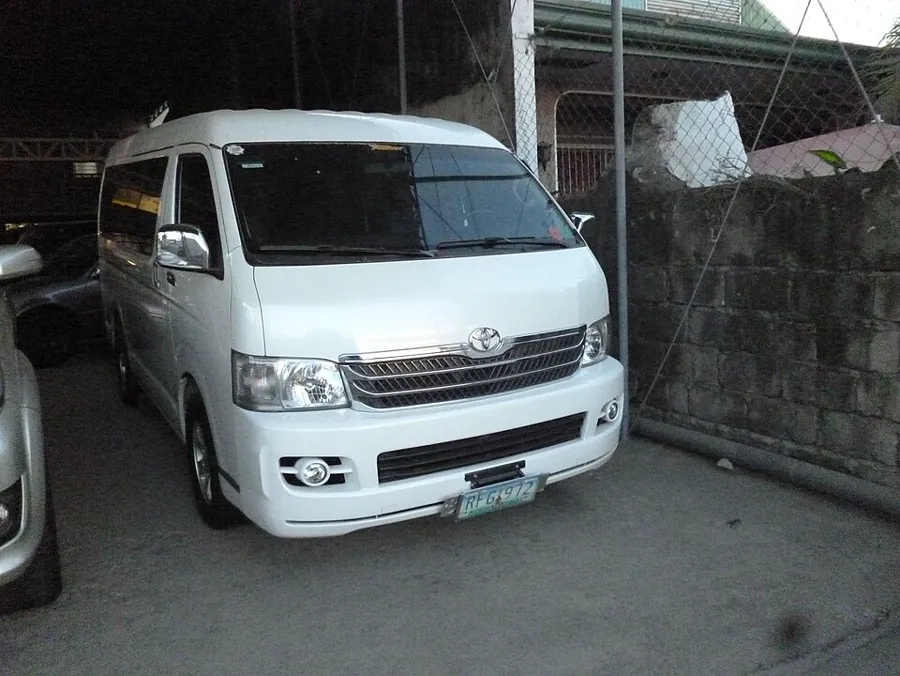
Toyota HiAce Super Grandia, 7 to 9 seats, 6 to 8 bags
The usual family answer. The extra legroom and the quieter cabin are what you want on the long southern drives, and there is room to fit two seats without anyone sitting against a suitcase.
Toyota HiAce Commuter, up to 12 seats, 10 to 12 bags
For larger family groups, or a family travelling with grandparents and a full set of luggage. Above twelve passengers a group travels in two vehicles kept together on one quote.
Small things that make the day work
Say when the nap is
On a day tour or a multi-day booking the driver can shape the stops around nap times and mealtimes rather than a fixed schedule. That only happens if you say so at the start of the day, so mention it in the quote request.
Whale sharks mean an early start
The Oslob briefings run early in the morning, so a same-day return from Cebu City means leaving in the small hours with a 3 to 3.5 hour drive at each end. Families almost always have a better trip staying south the night before.
Count the stroller as a bag
A pushchair takes roughly the space of a medium suitcase once it is folded. Add it to the bag count you send us rather than to the passenger count.
Ask for the same driver on a multi-day trip
Over several days with children it is worth more than it sounds: the driver already knows the routine, the seats stay fitted, and nobody re-explains the plan each morning.
What the quote covers
- A private air-conditioned car or van with an English-speaking local driver for the whole journey
- Door-to-door pickup and drop-off at the exact addresses you give us, not a meeting point
- Fuel, tolls and parking
- Waiting time and any extra stops you tell us about up front, priced into the quote rather than added afterwards
- One fixed all-in price for the trip, agreed in writing before you travel
- Entrance, activity, guide and boat fees at places you choose to stop (paid locally)
- Meals and personal spending
- Accommodation, including a driver overnight on a multi-day trip unless we have set it out in the quote
- Inter-island ferry and boat crossings, unless we have set them out in the quote
We never invent activity or entrance prices - you pay those directly on the ground.
Frequently asked questions
Do I legally need a car seat for my child in the Philippines?
Yes, in most cases. Republic Act 11229, the Child Safety in Motor Vehicles Act of 2019, requires a child to be secured in an appropriate child restraint system unless they are at least 150 centimetres (59 inches) tall and can use the regular seat belt. The requirement is written around height rather than age, and the Act defines a child as anyone twelve years old and below.
Can my child sit in the front seat of the car in Cebu?
Not if they are twelve or under, unless they are at least 150 centimetres tall and wearing the regular seat belt. Section 5 of RA 11229 keeps children of that age in the rear seats while the vehicle is being driven.
Can Cebu.travel provide child seats?
Yes, arranged in advance. Ask when you request your quote and send the children’s ages along with rough heights and weights, so the right size of seat is fitted before pickup rather than sorted out at the kerb. The law requires a restraint appropriate to age, height and weight, which is why all three help.
How long a drive can a toddler realistically manage in Cebu?
The comfortable ceiling for most young children is around two hours one way, which covers Carcar at 1 to 1.5 hours and Simala Shrine at 1.5 to 2. Moalboal at 2.5 to 3 hours and Osmeña Peak at 2.5 to 3 are a genuine full day. Oslob, Kawasan, Bantayan and Malapascua are 3 to 4.5 hours each way and are far better as an overnight than a same-day return.
Is Oslob to see the whale sharks realistic with small children?
It is, but not as a day trip from Cebu City with a toddler. The drive is 3 to 3.5 hours each way from the city, and the viewing happens early in the morning, so a same-day return means starting in the middle of the night. Staying in the south the night before turns it into a manageable morning instead of a fourteen-hour day.
What size vehicle do we need for a family with a pushchair?
Count the child seats as seats and the pushchair as a bag. A family of four with two child seats, four suitcases and a folded pushchair is comfortable in a Toyota HiAce Super Grandia, which carries 7 to 9 people and 6 to 8 bags. A Toyota Vios, at 1 to 3 seats and 2 to 3 bags, is only realistic for a couple with one small child and light luggage.
Are tricycles and motorcycles covered by the car seat law?
No. Section 3 of RA 11229 expressly excludes tricycles and motorcycles from its definition of a motor vehicle, which is why you will see children travelling on them. That is a limit on the scope of the law rather than an indication that it is a safe way to move small children around.
What does a private car and driver quote for this trip include?
One fixed all-in price for the trip, agreed in writing before you travel, with fuel, tolls and parking inside it - along with any waiting time or extra stops you tell us about when you ask. What stays separate is what you would choose anyway: entrance, activity and boat fees at the places you stop, your meals, and your accommodation. We do not invent activity prices, so those you pay directly on the ground.